top of page

PRONTO XI CRM

An AI-Powered, Role-Based CRM That Grew the Business

Success Matrix

35% increase in module upgrades (licensing) . AI capabilities embedded directly into daily workflows

Why

Pronto Xi's CRM was a records system — it stored what users typed in, but did nothing with it. Sales reps logged activity into a void; managers chased updates manually; the platform knew everything and surfaced nothing. Meanwhile the market moved to AI-native CRM, and Pronto risked looking a generation behind.

How

I rebuilt the CRM around a single idea — the system should do the thinking the user shouldn't have to. Role-based dashboards, AI surfaced directly in context, and a clean information architecture that replaced buried menus with what each role actually needs first.

What I solved

Turned a passive records system into an active decision-support platform — lead scoring, next-best-action, forecasting, and automated activity capture, all delivered through role-specific workspaces. The redesign drove a 35% lift in module upgrades and opened a new small-to-medium business market Pronto hadn't previously won.

THE PROBLEM

The old CRM treated every user identically and every record equally. A sales rep, a sales manager, and a service agent saw the same dense interface, the same undifferentiated data, the same manual workflows.
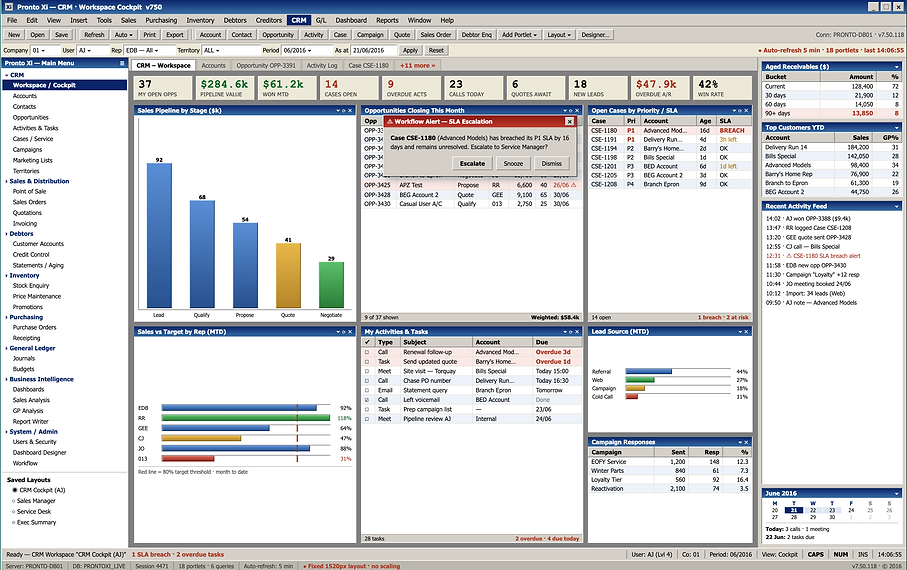
Three failures compounded:It captured, but didn't compute. Reps entered data the system never turned into insight — no scoring, no prioritisation, no forecasting.It served no role well. One generic layout meant everyone navigated past what they didn't need to reach what they did.It was falling behind the market. AI-native competitors were setting a new baseline; Pronto's CRM felt static beside them.

Screenshot 2026-08-14 at 9.42.58 am.png

COMPETITOR ANALYSIS

I benchmarked against the platforms Pronto's prospects were actually evaluating:

1.Salesforce — the enterprise benchmark, with Agentforce driving lead scoring and autonomous agents. Powerful, but complex and expensive to implement.

2.Microsoft Dynamics 365 — deep Microsoft-ecosystem integration and Copilot for Sales; strong in large enterprises already on the Microsoft stack.

3.HubSpot — the accessibility play: a unified, fast-to-adopt interface winning mid-market and growth-stage teams.

4.Zoho, Freshworks, Pipedrive — aggressive on price and simplicity in the SMB segment.

The strategic gap I designed into: the incumbents win large enterprises but are heavy, costly, and slow to implement. Pronto Xi already had ERP depth — CRM plus operations on one platform, the same architecture Odoo and NetSuite compete on.


My job was to make the CRM feel as modern and AI-capable as HubSpot, while leaning on Pronto's ERP-integrated advantage.


That combination is what opened the small-to-medium business market — modern AI experience, without Salesforce-scale cost and complexity.

RESEARCH

A research-dense discovery phase, because a multi-role platform can't be designed from assumption:

  • Stakeholder and user interviews across sales, service, and management

  • Contextual inquiry — observing how reps and managers actually worked, not how the system assumed they did

  • Competitor benchmarking (above)

  • Heuristic evaluation of the existing CRM

  • 30 usability and user testing sessions across roles, spanning wireframes through to high-fidelity prototypes

The insight that reframed everything: users weren't struggling because data was missing — they were struggling because the system made them do all the thinking themselves. The fix wasn't more fields. It was intelligence.

Screenshot 2026-08-14 at 10.15.41 am.png
Screenshot 2026-08-14 at 10.17.49 am.png
Screenshot 2026-08-14 at 10.37.03 am.png

MULTI-ROLE JOURNEY MAP

The redesign lives or dies on serving distinct roles from one platform. I mapped three:

One CRM. One design system. Three genuinely different jobs — each served by a workspace configured for it, not a generic layout everyone fights.

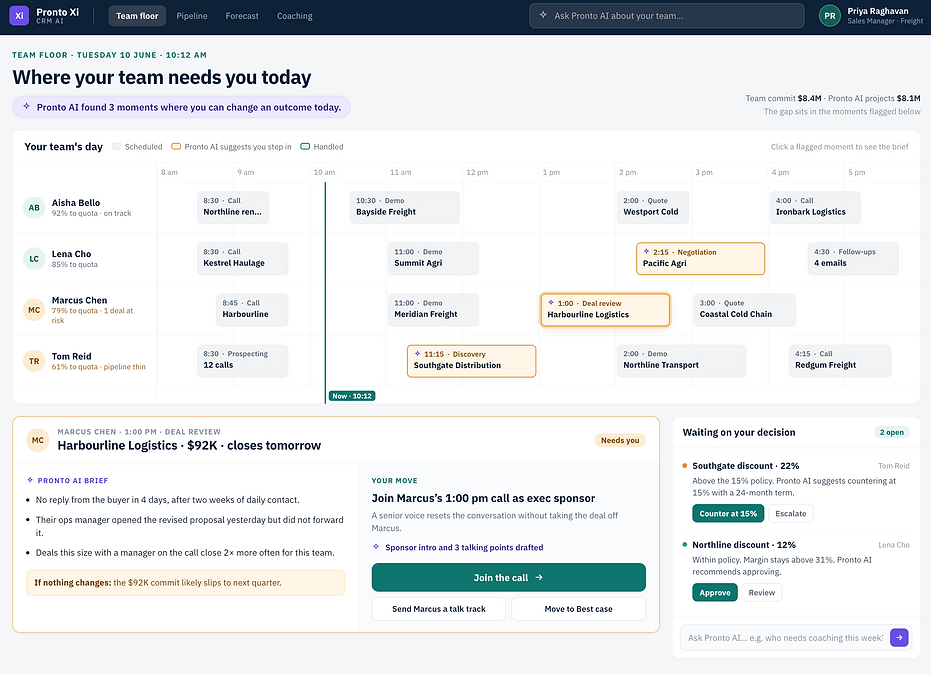
SALES REP — "What should I do next?" Lands on a prioritised pipeline, AI lead scores surfacing the deals worth attention first → activity auto-captured, no manual logging → next-best-action recommended in context → acts, instead of administrating.

Screenshot 2026-08-14 at 9.58.51 pm.png
Screenshot 2026-08-10 at 11.50.53 pm.png

SALES MANAGER — "How is the team tracking?" Lands on team performance and AI forecasting → spots an underperforming rep or at-risk deal via surfaced signals, not manual digging → coaches based on evidence → forecasts with confidence, not guesswork.

Screenshot 2026-08-16 at 7.20.10 pm.png
Screenshot 2026-08-14 at 9.45.44 am.png

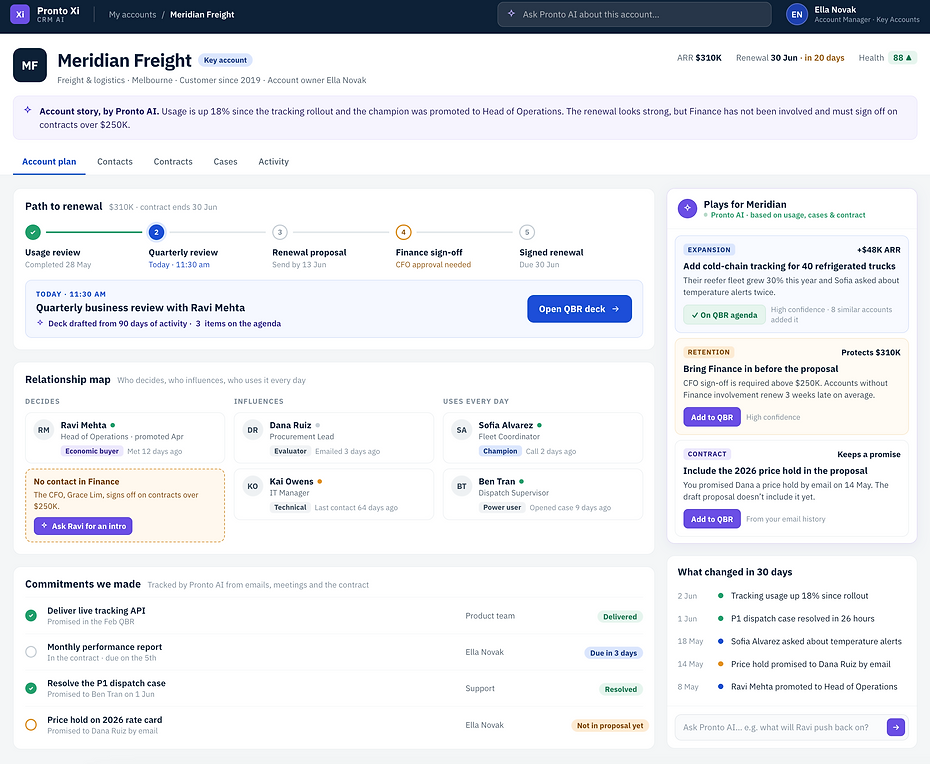
SERVICE AGENT — "What needs me first?" Lands on a prioritised case queue → full customer context assembled automatically → resolves faster with the history already in front of them → escalates cleanly when needed.

Screenshot 2026-08-16 at 7.25.52 pm.png
Screenshot 2026-08-14 at 9.48.55 am.png

THE AI LAYER

AI wasn't a bolted-on chatbot. It was embedded into the workflows users were already in:

​

  • Lead scoring — surfaces which deals deserve attention first, so reps stop guessing.

  • Activity capture — logs interactions automatically, ending manual data entry.

  • Next-best-action — recommends the specific next step, in context, at the point of decision.

  • Forecasting — gives managers evidence-based pipeline predictions, not gut feel.

  • Ask Pronto AI — a conversational layer to query the CRM in plain language.

  • Role-based dashboard intelligence — the same AI engine surfaces different insights depending on who's logged in, so a rep, manager, and agent each see what matters to them.

​

The design principle throughout: the interface has to know who's looking and what they're responsible for before AI can be useful. Role-based architecture and AI weren't two features — they were the same decision.

Screenshot 2026-08-14 at 9.59.10 am.png
Screenshot 2026-08-14 at 9.59.18 am.png

DESIGN SYSTEM & IA

Scalable by design — built on the Pronto Xi hybrid design system (IBM Carbon principles + Pronto-native components), so every CRM screen inherited consistency and every new module could reuse the patterns.


Clean information architecture — replaced buried, undifferentiated menus with role-first navigation: what you need, where you'd expect it, nothing you don't.Reduced forms — inline actions and auto-capture replaced navigate-to-form workflows, cutting steps out of high-frequency tasks.

OUTCOMES

Business

  • 35% increase in module upgrades — the redesigned CRM directly drove existing clients to upgrade.

  • New market opened — the modern, AI-capable, ERP-integrated experience won small-to-medium business clients Pronto hadn't previously competed for.

  • Leadership recognition — the CRM redesign was recognised internally as a driver of licensing growth and competitive positioning.

Experience

  • Faster task completion across all three roles in testing.

  • Manual data entry sharply reduced through automated activity capture.

  • Managers forecasting on evidence instead of guesswork.

PlatformRole-based, AI-ready CRM architecture reusable across the wider Pronto Xi platform.

CONCLUSION

This wasn't a redesign that made the CRM look better. It was a redesign that made the business grow. A 35% lift in module upgrades, a new small-to-medium business market opened, and a role-based AI system that gives every user — rep, manager, agent — exactly what they need to act, not just what the database happened to store.

NDA Statement: To respect confidentiality, certain details including data, visuals, and system specifics have been adapted or abstracted. The focus is on showcasing design approach, thinking, and impact."

bottom of page